Cooking classes in Marrakech are one of the easiest ways to understand Moroccan food beyond simply eating in restaurants.
A good class lets you see how spices are used, how a tajine is built, how ingredients are chosen and how Moroccan dishes come together step by step.
Some classes include a visit to a local souk before cooking, while others focus entirely on the kitchen. You can also choose between small-group workshops, private classes and more luxurious hotel experiences.
This guide explains what to expect, what you may cook, how long classes take, what prices look like and how to choose the right cooking experience in Marrakech.
Quick Facts
Typical duration: Around 3 to 4 hours
Common dishes: Tajine, couscous, Moroccan salads, pastilla and bread
Market visit: Included in some classes
Best for: Food lovers, couples, families and travelers who enjoy hands-on experiences
Group style: Shared or private
Dietary options: Vegetarian options are common, but always confirm in advance
What Actually Happens During a Marrakech Cooking Class?
The format depends on the class, but many experiences follow a similar rhythm.
You may start with tea and an introduction to Moroccan ingredients, then head to a nearby market to choose vegetables, herbs and spices.
After that, you return to the kitchen and start preparing the meal.
A hands-on class usually means you are actively chopping, seasoning and cooking rather than only watching a chef.
At the end, you normally sit down and eat what you prepared.
For example, Riad Vendôme currently offers a three-hour experience that includes a souk visit, hands-on cooking and lunch.
What Can You Learn to Cook?
Tajine

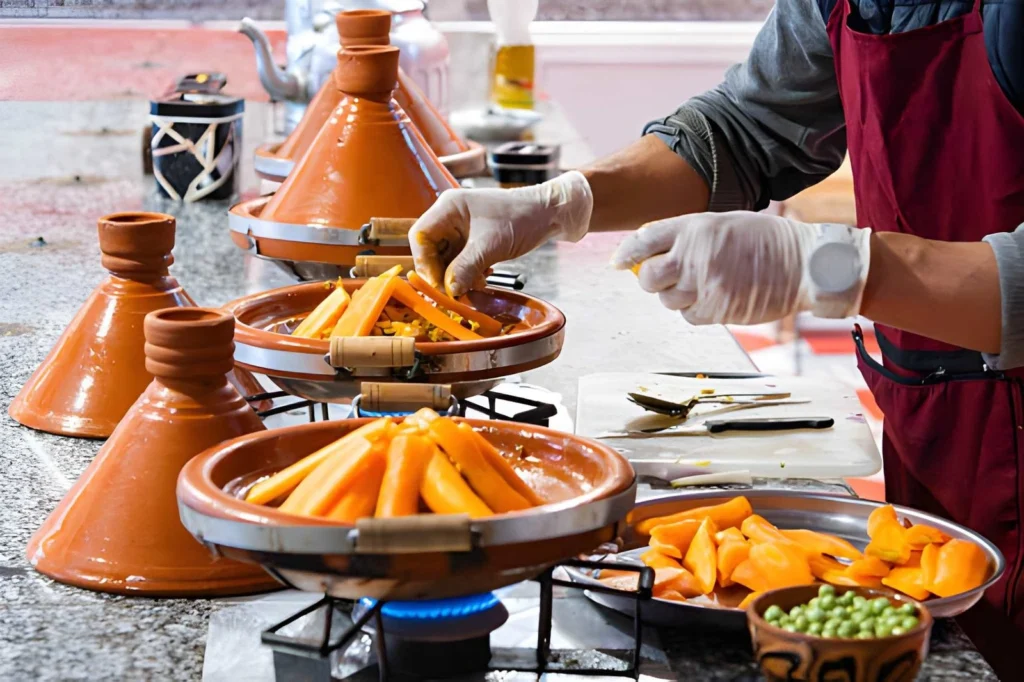
Tajine is one of the most common dishes taught.
You may learn how to layer ingredients, use spices correctly and control slow cooking.
Chicken with preserved lemon and olives, kefta and vegetable tajines are common options.
Couscous

Couscous is more time-consuming and is not offered in every short class.
If this is the dish you specifically want to learn, check the menu before booking.
Moroccan Salads
Zaalouk, taktouka and carrot salads are common additions to cooking workshops.
These are useful because they introduce Moroccan spice combinations in a simpler way than a full main course.
Pastilla

Some longer or more advanced classes include pastilla.
This usually requires more preparation than a basic tajine class, so it may only appear in certain programs.
Is a Souk Visit Worth Including?


For me, this is one of the things that can make a cooking class more interesting.
A souk visit gives you context before you start cooking.
You can see where herbs, spices, vegetables and other ingredients come from instead of arriving directly at a prepared workstation.
Some classes make the market visit a central part of the experience. Riad Vendôme, for example, includes a guided spice-market visit before cooking.
If you have already spent a lot of time exploring food markets independently, you may prefer a class that gives more time to actual cooking.
How Long Do Cooking Classes Take?
Most classes take around three to four hours.
Some are shorter, while others can take half a day if they include a market visit, several dishes and a long meal afterward.
Riad Vendôme currently lists its standard class at around three hours.
Do not plan another timed activity immediately afterward.
Cooking classes often run a little longer once the meal and conversation begin.
How Much Do Cooking Classes in Marrakech Cost?
Prices vary a lot depending on the setting and what is included.
At the lower end, some riad-based experiences currently start around €48 per person. Riad Vendôme lists a three-hour class with market visit, cooking and lunch from €48 per person.
Private classes, luxury hotels and premium experiences can cost significantly more.
The price usually depends on:
- Private or shared class
- Number of dishes
- Souk visit
- Group size
- Venue
- Transfers
- Drinks
- Recipe booklet or extras
I would not choose only by the cheapest price.
Check what you actually get for the money.
Shared vs Private Cooking Classes


A shared class is usually better value and more social.
You cook with other travelers and often eat together afterward.
A private class gives you more attention from the instructor and can be better if you have specific dietary needs or want to focus on a particular dish.
For most first-time visitors, a small-group class is enough.
Are Cooking Classes Good for Beginners?
Yes.
Most cooking classes in Marrakech are designed for travelers, not professional chefs.
You usually do not need any previous cooking experience.
The instructor guides you through the process, and the recipes are normally adapted so beginners can follow.
Vegetarian and Dietary Needs
Vegetarian options are fairly common.
Vegan, gluten-free and allergy-specific requests require more planning.
Always contact the provider before booking if you have an allergy or strict dietary requirement.
Do not wait until the class starts.
If you want to compare cooking classes in Marrakech, including tajine workshops, souk visits and small-group experiences, you can check current options below. I may earn a small commission if you book through this link, at no extra cost to you.
How to Choose a Good Cooking Class
Before booking, check these details:
- Is it hands-on or demonstration only?
- Is the souk visit included?
- What dishes will you prepare?
- How large is the group?
- Is the meal included?
- Can they accommodate dietary needs?
- What language is the class taught in?
- Where is the meeting point?
The clearer the description, the easier it is to know whether the class suits you.
Medina Cooking Class vs Outside the City
A Medina class is usually the easiest choice.
You are close to the souks, ingredients and traditional riad settings.
A class outside Marrakech can offer more space and sometimes a garden or farm-style atmosphere.
Neither is automatically better.
Choose based on whether you want convenience or a slower countryside setting.
Cooking Class vs Food Tour
A cooking class is more practical.
You learn how to make dishes yourself.
A food tour is more about tasting multiple foods while moving through the city.
If you want to learn techniques you can repeat at home, choose a cooking class.
If you prefer trying many foods without cooking, a food tour may suit you better.
If you are still getting familiar with the city, my First Time in Marrakech guide explains practical basics such as transport, money and navigating the Medina before joining local experiences.
Can You Fit a Cooking Class Into a Short Trip?
Yes.
Because most classes take around half a day, they are easy to combine with sightseeing.
A morning class leaves the afternoon free.
An afternoon class works well after a lighter morning.
If you are staying only a few days, avoid scheduling it on a day already packed with several attractions.
My 2 Days in Marrakech itinerary shows how to balance major sights with slower experiences such as food, gardens and hammams.
Cooking Class or Hammam?
These experiences are very different.
A cooking class is social, practical and food-focused.
A hammamis more about bathing, exfoliation and relaxation.
If you want a cultural activity where you actively participate, cooking may suit you more.
If you want to slow down and relax, a hammam may be a better fit.
If you are considering both, my Best Hammams in Marrakech guide explains the difference between traditional local hammams and tourist spa experiences.
Common Mistakes to Avoid
One mistake is booking without checking what dishes are included.
Another is assuming every cooking class has a market visit.
Do not assume every class is hands-on either.
Some are closer to demonstrations.
Also, mention dietary restrictions before you pay.
Are Cooking Classes Good for Families?
Yes, depending on the age of the children.
Cooking can be a fun activity for families because it is more interactive than sightseeing.
However, check age requirements and whether children can participate safely around knives and hot cooking surfaces.
Is a Cooking Class in Marrakech Worth It?
It can be, especially if Moroccan food is one of the reasons you are visiting.
A good class gives you more than a meal.
You understand how ingredients are combined, how spices are used and how traditional dishes are prepared.
The best value comes from a class that is genuinely hands-on and gives you enough time to cook rather than simply watch.
Frequently Asked Questions
How long is a cooking class in Marrakech?
Usually around three to four hours.
What dishes can you learn?
Common options include tajine, couscous, Moroccan salads, pastilla and bread.
Do classes include a souk visit?
Some do, but not all.
Always check before booking.
Are vegetarian classes available?
Yes, many providers can offer vegetarian options.
Do you eat what you cook?
Usually yes.
Are classes suitable for beginners?
Yes. Most are designed for travelers of all skill levels.
Should you book in advance?
It is a good idea, especially for small-group or private classes.
Final Thoughts
Cooking classes in Marrakech are a good choice if you want to understand Moroccan food rather than only taste it.
A class with a souk visit gives you more context, while a smaller hands-on workshop usually gives you more time to cook.